Adaptive learning architectures
How AI personalises and transforms in-company training
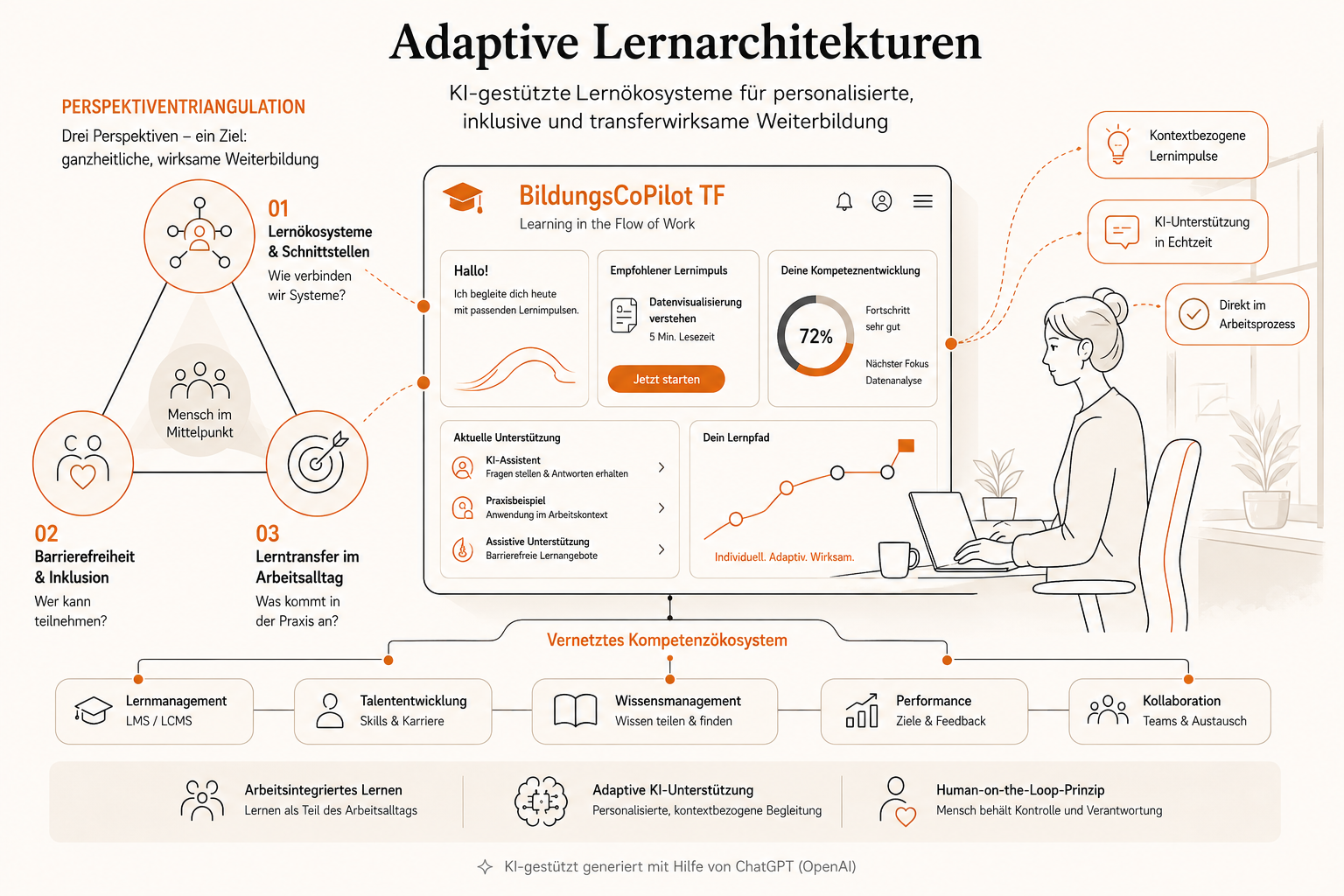
As part of our project work, we investigated how artificial intelligence can bring about lasting change to and support corporate continuing professional development through adaptive learning architectures. Our starting point was the question of how learning can be made more personalised, inclusive and transferable without removing people from the centre of the learning process. The aim was to provide learners with the best possible support through AI-enabled learning ecosystems, whilst maintaining human guidance as an essential component of modern continuing professional development. To this end, we developed an interdisciplinary approach that combines three thematic areas through a triangulation of perspectives: the development of AI-supported learning ecosystems, the promotion of accessibility and inclusion, and the sustainable transfer of learning into everyday working life. In doing so, we view learning as part of a networked competence ecosystem in which learning management, talent development, knowledge management and performance management are intelligently interconnected. As a practical future scenario, we devised the BildungsCoPilot TF – a prototype AI-supported learning companion that provides context-specific support to employees during their daily work. The BildungsCoPilot TF serves as a conceptual model to illustrate how personalised learning prompts, adaptive support and assistive functions can be integrated directly into the work process. At the same time, the concept demonstrates that AI does not replace human support, but rather supports staff development and managers in line with the ‘human-on-the-loop’ principle. Our project highlights that adaptive learning architectures go far beyond the automation of existing learning programmes.