Predicting Marathon Finisher Time
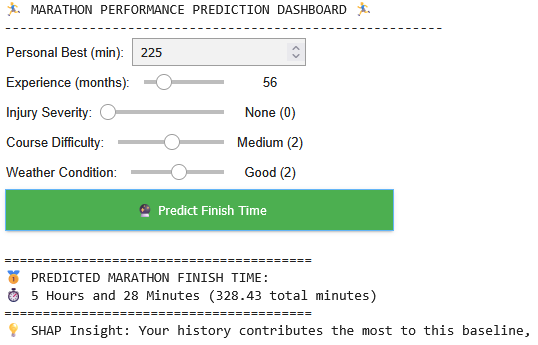
This project developed a machine learning pipeline to predict marathon finishing times using accessible training and physiological data. Working with a synthetic dataset of 100,000 runner profiles, we reduced the feature space to 23 variables and engineered key metrics, including relative_experience and heart_efficiency (a proxy for cardiac economy). Lasso regression identified baseline speed, experience, and cardiac efficiency as the primary independent predictors. Among six evaluated models (ranging from linear forms to neural networks), XGBoost achieved optimal performance with an MAE of 9.87 minutes and an R2 of 86.23%. SHAP analysis validated that predictions align with sports science principles, highlighting personal best, cardiac economy, and injury history as dominant factors. Finally, an interactive ipywidgets dashboard was implemented for real-time validation.